01
Valence House Museum
A timber-framed manor house from the 15th century holding the borough's local history collection, with free entry Tuesday to Saturday and gardens to wander outside.
Learn more about Valence House Museum on Google MapsUpminster, RM14 - covering Hornchurch, Romford and the whole of Havering
Patios in Dagenham start with Becontree. The London County Council built the estate between 1921 and 1935: two-storey brick cottages with a garden front and back, and most of Dagenham still lives in them. The back garden is where people want to sit. It is also where a century of sheds, paths and DIY slabs has piled up. Under it, in the northern avenues around Valence Avenue and Becontree Heath, is London Clay. It holds water and moves with the seasons. Further south, towards Dagenham Dock, it turns to river alluvium. We clear the old stuff out, build the base for the ground you have and lay a terrace that stays flat.
We reply the same working day, usually within the hour.
Dagenham is five stops west of Upminster on the District line, well inside the patch Jim and his family cover. Patios have been part of their trade for 35 years, alongside every kind of driveway.
Plenty of Dagenham back gardens have old slabs and concrete to clear before anything new goes down. Most of our customers come to us through word of mouth, and keeping our travel short keeps the price of a new patio lean.
01
Becontree gardens are narrower than most people's plans assume. We peg the terrace out on the grass first, so you can see where the table goes and how much lawn is left before you sign anything.
02
London Clay swells in a wet winter and shrinks in a dry summer. We dig to firm ground, lay geotextile and compact 100 to 150 mm of MOT Type 1 in two layers. That is what keeps slabs level.
03
Plenty of Dagenham gardens have old slabs on sand over older slabs on soil. We break the lot out and take it away. Building on rubble nobody can vouch for is how patios crack.
04
Every terrace falls at least 1 in 80 away from the house. On clay that will not drain, the run-off goes to a gravel strip or channel at the garden end, not the foot of your wall.
05
Concrete slabs from £75 per m², sandstone and limestone in the middle, porcelain at the top. We tell you what each one is like to live with, not just what it costs on the day.
06
Our crew lays a plain 25 m² Becontree terrace, no steps or walls, in three to four working days. Short jobs matter when the only way into the garden is through the hall and the kitchen.
Local
Upminster Based
Hornchurch, Upminster and across Havering
6
Surface Types
Resin to gravel, one crew for all of it
Free
Site Visits & Quotes
Written, itemised and fixed
Written
Guarantee
Handed over on paper at the final walk-round
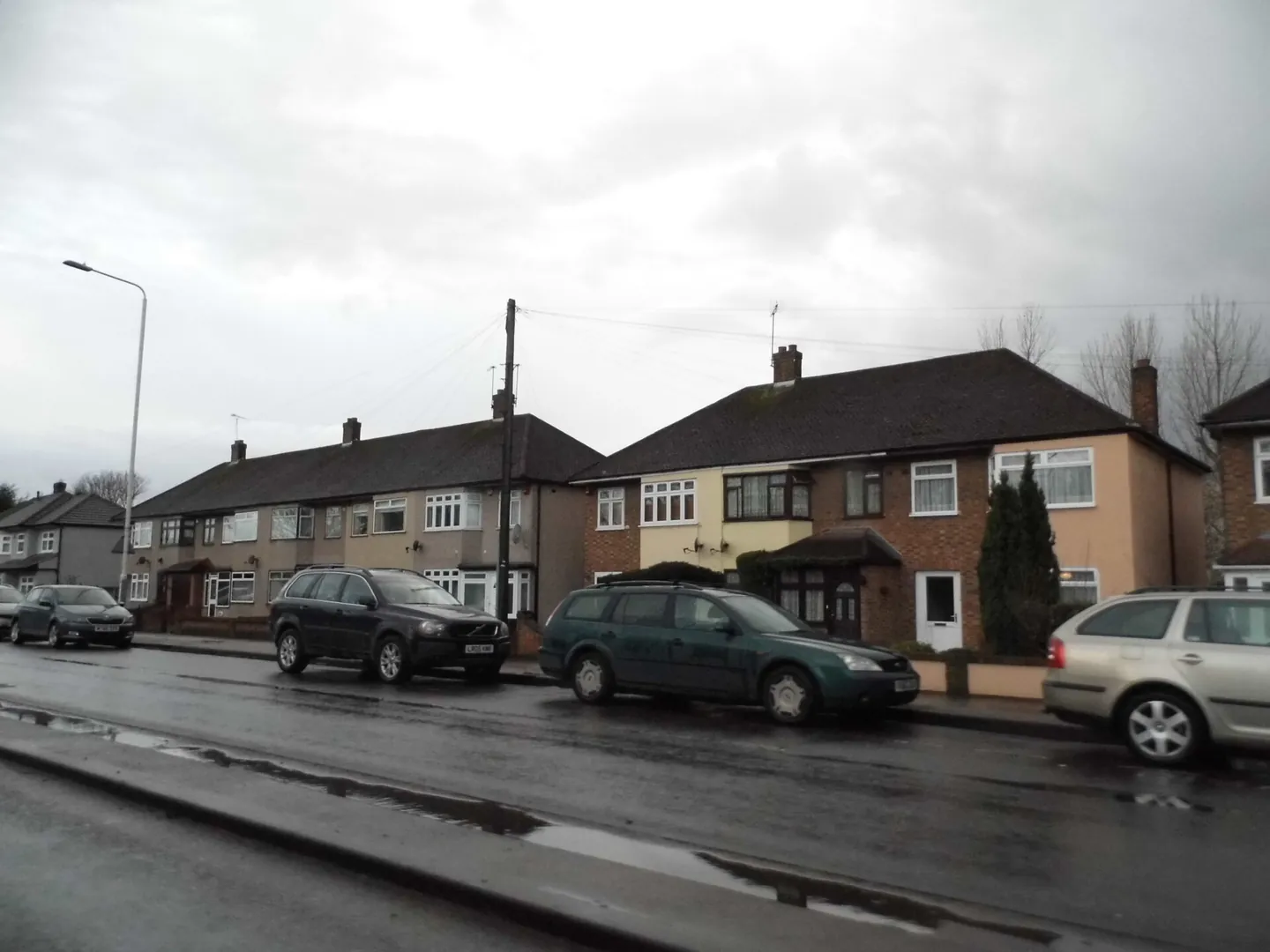
The estate went up fast. Dagenham grew from about 9,000 people in 1921 to nearly 90,000 by 1931, and the cottages were laid along wide avenues with Heathway as the spine. Gardens were for hedges, washing lines and vegetables. Nobody planned for paving. Today the typical back garden has a concrete strip by the kitchen, a path to the shed and grass that turns to mud in January. A patio sorts out the part nearest the house. If the front is breaking up as well, we can price repairing the driveway at the front of a Becontree house on the same visit.
Ground is the bit people forget. Geological maps of the area show London Clay across the north of Dagenham, a strip of Taplow gravel along its northern edge and alluvium over most of the south down to the Thames. Clay means a deeper dig and a membrane. Alluvium means planning where the water goes, because the soil will not take it. Barking and Dagenham Council handles planning, with applications processed by Be First, but a back-garden patio rarely needs one. What it does need is a base built for that ground.
Planning authority: Barking and Dagenham Council
Seven steps. The first three decide whether your Dagenham patio is still level after a few winters on clay.
We measure up, find the damp-proof course and take levels across the garden. On Becontree plots we also look hard at the back door threshold, because some have been raised or lowered over the years.
You get a plan with the slab, pattern, edges and any step marked, plus one written price. No day rate. No extras turning up halfway through the job.
Old slabs, concrete and turf come out and go in the skip. We dig to firm clay, which usually means going a good deal deeper than whoever laid the last patio.
Geotextile goes down on soft clay. Then 100 to 150 mm of MOT Type 1, compacted in two layers. You never see this part once the slabs are down, and it matters most.
Edge restraints stop the outer slabs creeping into the lawn. The fall runs away from the house at 1 in 80 or more, and the water is taken to a gravel strip or channel.
Each slab sits on a full bed of mortar. Porcelain gets a bonding primer on the back. We check every slab against the string line and the level as we go.
Two-part resin jointing fills the gaps. Walk on it the next day. Keep the furniture off for two or three days. We look round it with you before we pack up.
Not sure which surface suits the house? The cost guide compares all six side by side, and the site visit is free either way.
Most guarantees in this trade cover the surface, because the surface is the easy bit. Ours is written around the structure underneath, which is where a driveway on Havering's London clay either holds or does not. We put the excavation depth, the compacted MOT Type 1 thickness, the concrete haunch behind every edge and the drainage route on the quote, and we guarantee that build. If the surface sinks, spreads or ponds because any of that was not done right, we come back and fix it at our cost.
In
Writing, before we start
The guarantee terms go on the quote, not on a leaflet after the job
0
Overlays on a bad base
We will not lay a new surface over a base that has already failed, however cheap it would make the quote
Ask what they will do with what is already there. If the answer is to lay over your old concrete, walk away. Becontree gardens are full of slabs put straight on soil, and anything laid on top inherits their movement. A good installer will want to see under them, break them out and build fresh. That costs more in labour and skip hire. It is also the only way the new terrace gets a fair start on ground like this.
Ask how deep they are going and what goes down first on clay. You want to hear a depth to firm ground, a geotextile membrane where the clay is soft, and 100 to 150 mm of compacted MOT Type 1. Anyone who talks about a bit of sand and cement is describing the patio you are trying to get rid of. Clay in north Dagenham finds out a thin base within a couple of winters, and the slabs by the door go first.
Ask about the joints and the fall. Resin jointing or sand and cement? Which way does the water run, and where does it end up? In a narrow cottage garden the answer cannot be towards next door. If they cannot give you a straight answer on site, they will not give you a straight patio either. Get every one of those answers written into the quote. That way there is no argument later about what was promised.
Blunt version: porcelain is the easiest to live with, concrete is the cheapest, and the two natural stones sit in between. Here is how they differ.
| Option | Porcelain | Indian sandstone | Limestone | Concrete slabs |
|---|---|---|---|---|
| Laid price, per m² | £110-£150 | £90-£120 | £100-£135 | £75-£95 |
| Life on a good base | Decades, looks the same throughout | Decades, colour mellows with age | Long, but the surface is softer | Shortest of the four |
| Takes on water | Next to none | Some, less once sealed | More than sandstone | Quite a lot |
| Moss in a shady corner | Little to grip on | Grows if left alone | Shows up quickly | Grows readily |
| Next to 1920s brick | Sharp contrast, good with a new extension | Warm tones that sit well with old brick | Pale and smart, can look cold on red brick | Plain and practical |
| Cleaning | Hose and brush | Annual wash, reseal now and then | Mild cleaner only, no acids | Pressure wash every year |
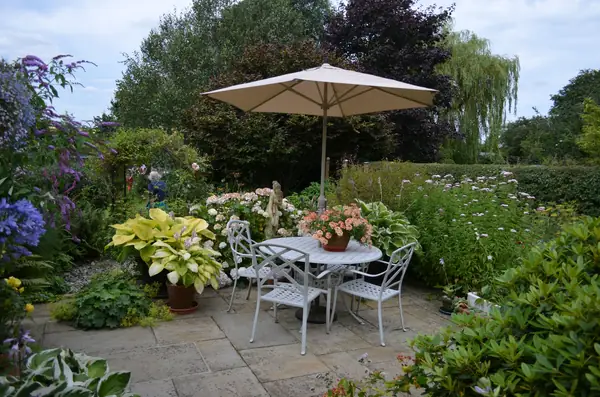
Narrow gardens look wider with slabs laid across the plot rather than along it. Large porcelain at 900 x 600 cuts the number of joints and suits a clean, modern look. Random-pattern sandstone hides small changes in level and works with the old brick. If the garden steps up from the house, build a proper step with a bullnose edge or a low wall instead of tilting the slabs. A slope that steep never drains right.
"In Dagenham back gardens, most of the patio jobs we price start with lifting an older layer of slabs or concrete that a previous owner laid themselves."
Based on enquiries and jobs handled by Hornchurch & Upminster Driveways.
We charge £90 to £150 per square metre laid, all in: dig, base, edging, slabs and jointing. A typical 25 m² terrace comes to £2,300 to £3,800, depending mainly on the stone. Becontree gardens are often smaller than that, so the bill is too. What pushes it up is breaking out old concrete, extra depth on clay, and any steps or walls. You get the figure in writing after the visit.
Guide price from
£90/m²
Dagenham prices are fixed in writing after a free site visit.
Get A Fixed QuoteClear out of the house while the crew works and pick one of these, all a short trip from Becontree.
01
A timber-framed manor house from the 15th century holding the borough's local history collection, with free entry Tuesday to Saturday and gardens to wander outside.
Learn more about Valence House Museum on Google Maps02
Meadows, lakes and flat paths on the eastern edge of Dagenham, linking into The Chase nature reserve, and a good hour's walk with a dog on day two of the cure.
Learn more about Eastbrookend Country Park on Google Maps03
The last piece of the Becontree plan, opened in 1935: 58 hectares of playing fields and open grass in the middle of the estate, big enough to lose an afternoon in.
Learn more about Parsloes Park on Google MapsWe cover all of Dagenham from Corbets Tey Road, including Becontree, Becontree Heath, Dagenham East and Rush Green.
Usually not. A patio in a rear garden is normally permitted development, so Barking and Dagenham Council, which has Be First process its planning applications, does not need to see it. You do need permission if the house is listed, if you live in a flat or maisonette (converted Becontree houses included), or if the patio raises ground levels a lot near a boundary. The front garden has its own rule: over five square metres of new hard surface needs permission unless it is permeable or drains to a lawn or border.
Not if the base is right. London Clay under north Dagenham swells when wet and shrinks when dry, and that movement is what sinks badly built patios. We dig down to firm ground, lay a geotextile membrane on soft clay and compact 100 to 150 mm of MOT Type 1 in two layers. The fall takes water away from the house to a gravel strip, so the clay under the slabs is not soaked every time it rains.
Yes. Mid-terrace houses on the estate often have no side passage. We sheet the floors, carry materials through in bags and barrows and take the spoil out the same way. It adds labour, and that shows in the quote. Pick a slab size that fits through the hallway too, because big-format porcelain can be awkward on a tight turn by the stairs.
Porcelain if you want the least cleaning and your garden is shaded or damp. It absorbs almost nothing, so algae struggles. Sandstone if you prefer a natural, varied look and a lower price, about £90 to £120 per m² against £110 to £150 for porcelain. Both are good on a proper base. Neither survives a bad one, which is why we spend most of our time on what goes underneath.
Our porcelain is 20 mm and our Indian sandstone is 22 mm calibrated, meaning each slab is cut to an even thickness. Calibrated stone lays flatter and faster than the hand-split kind. Thickness matters less than people think, though. A 22 mm slab on a solid base will outlast a much thicker slab dropped onto soil every time.
Yes, but it has to finish at least 150 mm below the damp-proof course and fall away from the house. On some Becontree houses that means digging the area by the door lower than the rest of the garden. If the ground rises from the house, we put in a step rather than cheat the fall. Water against the wall is the one thing we will not build in.
We would rather show you a driveway than a star rating.
Customer reviews are being collected and will appear here as they come in. In the meantime, when we come out to quote in Dagenham, ask to see photos of recent jobs on houses like yours - and ask the other firms quoting the same question. A finished drive two streets away tells you more than a testimonial ever will.
Ring us on 01708 209015, or use the form. We will measure the garden, check the ground and give you one fixed price in writing.